Thesis Type:
- Primary: Oversold, event-driven swing opportunity
- Secondary: Long-term compounder if regulatory overhang resolves
Company Overview
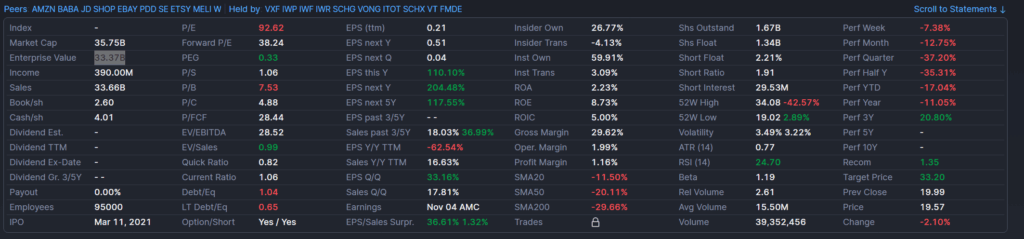
Coupang is a U.S.-incorporated, Korea-focused e-commerce and technology platform often described as the “Amazon of South Korea.” Founded in 2010 by Bom Kim, the company operates:
- 1P + 3P e-commerce marketplace
- Rocket Delivery (same-day / dawn delivery logistics network)
- Coupang Eats (food delivery)
- Coupang Play (OTT streaming incl. originals & sports)
- WOW Membership (bundled subscription similar to Amazon Prime)
Coupang’s competitive moat is its dense, vertically integrated fulfillment infrastructure, enabling industry-leading delivery speeds. This network has allowed the company to take consistent share from legacy retailers.
Execution Track Record
Since its March 2021 IPO, Coupang’s operational execution has been strong:
- Revenue growth (latest reported quarter, Nov 2025): ~18% YoY
- TTM Operating Cash Flow: ~$2.4B
- TTM Free Cash Flow: ~$1.3B
- FCF positive while still investing in expansion — a key inflection vs early IPO years
The company has also begun replicating its Korean playbook in Taiwan, an important move given Korea’s stagnant demographics. Future growth must come from:
- Further market share gains
- Higher monetization (ads, subscriptions, services)
- International expansion
Ownership & Alignment
- Founder/CEO Bom Kim: ~8% economic ownership but ~70% voting control (Class B)
- SoftBank: ~17% (down from ~34% in 2022)
- Baillie Gifford: ~9%
- Historically followed by high-profile investors (Druckenmiller, Tiger Global, etc.)
Founder control suggests long-term strategic continuity, but also contributes to governance perception issues in Korea.
Why stock has fallen since Q3 2025: The company was firing on all cylinders till mid 2025 when its’s fortunes took a bad turn when they got embroiled in regulatory crackdown from govt/antitrust/competition authorities in Korea.
Chain of Events leading to downfall:
1.In late November 2025, Coupang disclosed a major personal data breach, initially underestimating it at ~4,500 accounts but later confirming that personal information from ~33.7 million customers was compromised.(half of Korean population)
2. South Korean authorities launched broad internal investigations involving cybercrime units, consumer protection, and data protection enforcement following the breach.
3. There were reports that government agencies (including the Fair Trade Commission) were considering sanctions — including possible business suspension or penalties — although not formally imposed.
4.U.S. institutional investors — including major funds Greenoaks and Altimeter — filed arbitration claims under the U.S.–Korea Free Trade Agreement (KORUS), alleging that the South Korean government’s aggressive regulatory actions against Coupang were discriminatory and harmful to shareholders.
5. New competition: Meanwhile new competition has shown up from overseas mainly from Chinese discounter ecom retailers such as Ali-Express ($baba) & Temu ($PDD). They hv growth too fast with AliExpress attaining nearly 10 million monthly users, second only to Coupang’s roughly 32 million.
6. As of writing this post Trump is threatening new wave of tariffs on SKorea for currency manipulation which could put additional pressure on Coupang as the company is caught between USA & S.Korea
American or Korean: big confusion=> There is a lot of confusion whether this company is Korean or American & this is a big issue right now. So even though the founder Bom KIM is of korean origin & born in Korea. He moved to USA at age 7 & had his schooling there, the company was incorporated into the USA (Delaware corp) & then changed to Seoul Korea & then relocated back to Seattle USA in 2022. So, what’s the big deal here. Well this crisis is reputational & cultural in nature. Korean lawmakers/people see the company, its founder & culture as foreigner and the CEO’s attitude hasn’t helped much. Even before this data breach crisis he had regularly refused to attend summons from Korean lawmakers in parliament hearings as witnesses. He was seen as too snobbish/elitist (or American should i say). After public outrage, initially only the CEO of Korean operations, Park Dae-joon, was made to resign as he took the whole responsibility of data breach on himself. Finally, on 28th dec 2025, CEO issued a formal short apology but only related to data breach which seemed short of addressing previous issues such as workplace accidents & overwork condition. His ties to Korea — and lack of citizenship — have drawn criticism that commonly emerges when a foreign nationality or residential status is perceived to be used to evade responsibility in Korea, where leaders often take responsibility publicly in times of crisis, such as Samsung Electronics Executive Chairman Lee Jae-Yong, who attended parliamentary hearings and was jailed in relation to a scandal surrounding former President Park Geun-Hye. Public & lawmaker resentment has also erupted because they feel that Coupang’s CEO is exploiting its American incorporation base to avoid public scrutiny & CSR responsibilities in Korea
There is a feeling that has built among American investor base that this company is being unfairly targeted by Korean govt & they are even pressurizing Trump admin (trade/commerce dept) to intervene.
Immediate Risk : suspension of Korean business operations. I think that risk is neglibile but you never know with Koreans as political atmosphere is totally different to what we see in the west. Even Samsung scion and chair was put behind bards & its not uncommon for previous presidents to be jailed or convicted.
The linked article from Korea times sums up the situation in my opinion. ==> Suspension of Coupang feasible scenario, experts say – The Korea Times
“FTC Chairman Ju Biung-ghi reiterated that Coupang’s business operations could be suspended if it does not abide by the upcoming FTC order”.
“Experts say the authority may push ahead with the suspension in a show of regulatory resolve against companies engaging in unlawful and unfair business practices”.
Investment Thesis:
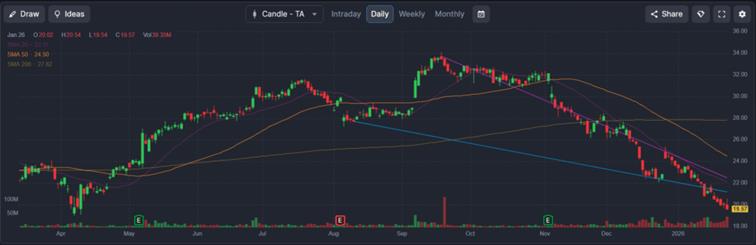
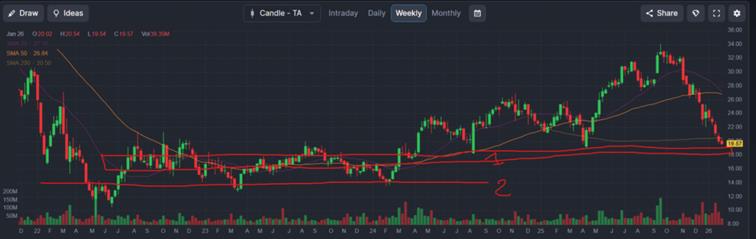
This is a regulatory overhang trade, not a broken-business story.
As you can see in the daily & weekly charts below the stock is at oversold level trading at EV/sales of around 1. I hv swing traded this name earlier too a lot of times on short-term weakness. But this time the issue in hand is more serious.
Base case:
- Regulatory pressure fades over time
- Company pays fines / adopts governance & compliance changes
- Political intensity declines as media cycle moves on
- Any sign of stabilization in regulatory tone could re-rate the stock quickly.
Valuation
- Trading near ~1x EV/Sales
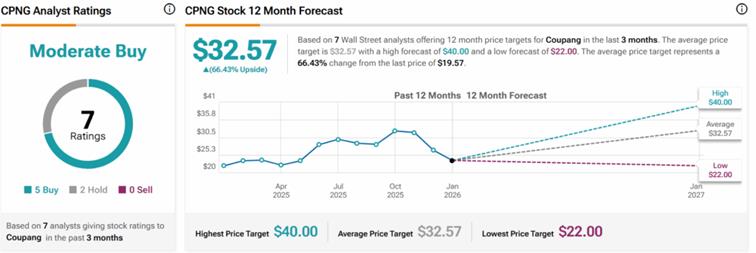
- Below lowest analyst PT (~$22)
- Average PT ~low $30s
- For a logistics-heavy, FCF-positive platform with market leadership, this is distressed-style pricing.
When that happens, valuation can revert toward historical ranges.
Technical Setup (For Swing Trade) :
Currently the stock is just above 1st level demand zone of 17-18$. Below 18 there is 2nd support level at 13$-14$. If 18$ psychological support can’t hold i would be seller now looking to reenter at 14$-13$ 2nd support zone.
for what’s its worth the current stock price is below the lowest analyst PT of $22 & avg PT is around $32. Next
Catalyst
Earnings: Feb 24, 2026
Key watch items:
- Update on regulatory discussions
- Membership growth
- Taiwan performance
- FCF trajectory
- Lower USD & higher WON would be a automatic boost to earnings in 2026.
Any sign of stabilization in regulatory tone could re-rate the stock quickly.
Bottom Line
Coupang is not being repriced due to deteriorating fundamentals, but due to a political and regulatory shock layered on a cultural narrative conflict.
These situations tend to be:
- Violent on the downside
- Powerful on relief
For traders: asymmetric bounce setup.
For long-term investors: chance to buy a logistics platform with a structural moat at distressed multiples — provided one can tolerate policy risk.
Disclaimer:
This write-up reflects personal opinions and is for informational and educational purposes only. It is not investment advice, a recommendation, or an offer to buy or sell any securities. The author may hold a position in the securities discussed. Investing in equities, especially in situations involving regulatory and political uncertainty, carries significant risk, including potential loss of capital. Readers should conduct their own research and consult a qualified financial advisor before making any investment decisions. Do Your Own Due Diligence (DYODD).

Leave a Reply